Opening a practice
How Much Does It Cost to Open an Optometry Practice?
 By Dr. Davinder Sidhu, OD
November 11, 2026 · 3 min read
I opened my first clinic at 29, after a couple of years as an associate. Since then I've looked at a lot of start-up budgets, and most of them count the build-out and the equipment carefully. Then the cash runs out a few months after opening.
The real start-up cost has four parts. There's the build-out, which turns an empty unit into exam lanes, a dispensary and a waiting room. There's the equipment. There's your opening inventory of frames, lenses and contact lens trials. And there's the money to cover rent, staff and loan payments while the schedule fills, which is the part people forget.
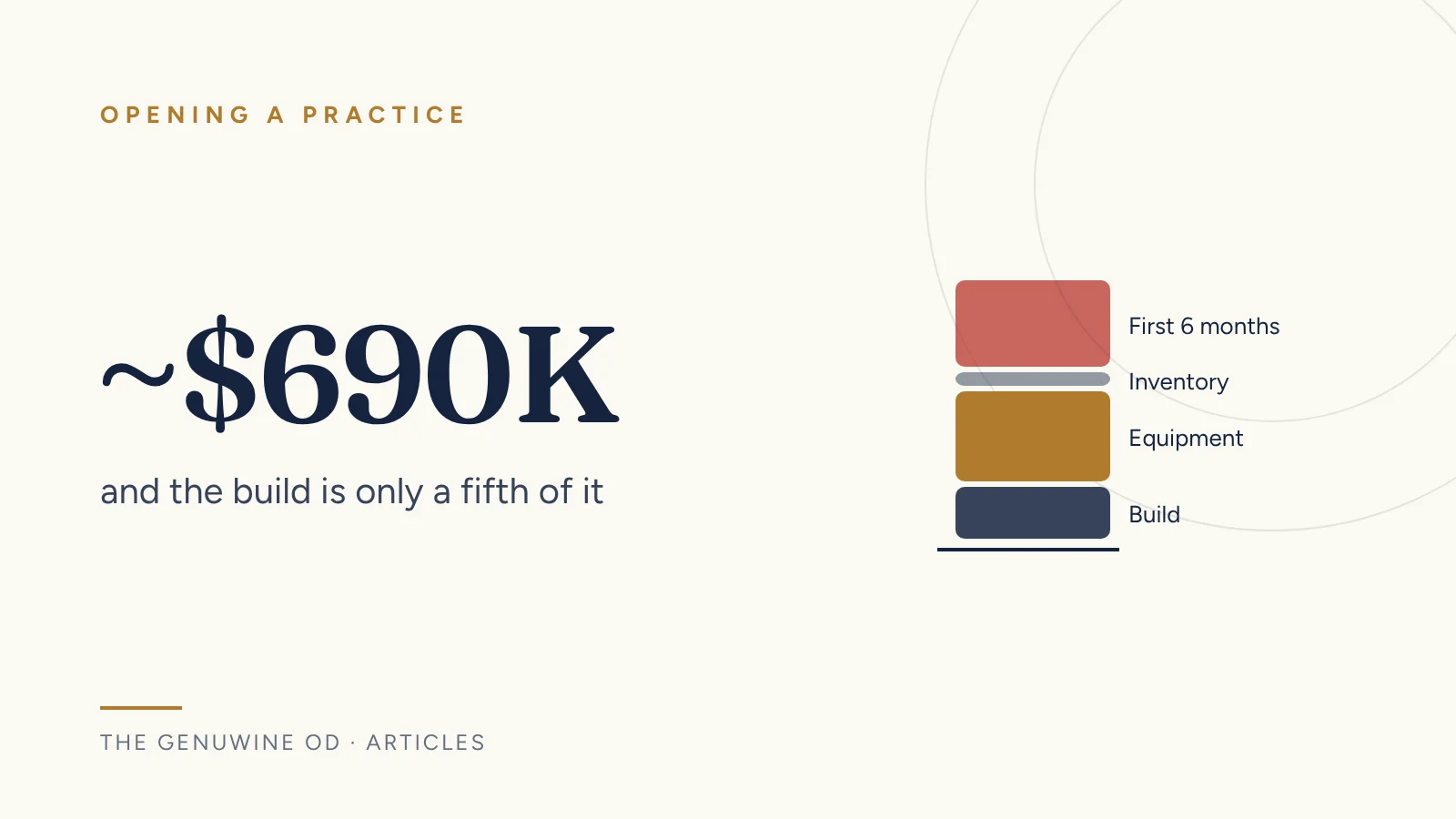
In a simple example, that's $150,000 for the build, $250,000 of equipment, $50,000 of inventory and $240,000 to get through the first six months, for about $690,000 in total. The build is only about a fifth of it.
A full budget, line by line
Here's the budget for a fictional two-lane cold start in a US suburb. Yours will look different, but the lines should all be there.
| Use of funds | Amount | % of total |
|---|---|---|
| Leasehold improvements | $150,000 | 23% |
| Equipment | $220,000 | 34% |
| Furniture, displays and fixtures | $35,000 | 5% |
| Computers, network and records software | $15,000 | 2% |
| Signage | $8,000 | 1% |
| Contingency (about 10% of build and equipment) | $42,800 | 7% |
| Opening inventory | $30,000 | 5% |
| Pre-opening marketing | $15,000 | 2% |
| Pre-opening rent, payroll and training | $20,000 | 3% |
| Legal, accounting, permits and licences | $10,000 | 2% |
| Working capital reserve | $97,189 | 15% |
| Total project | $642,989 | 100% |
The owner puts in $65,000 of their own cash, about 10%, and the bank lends the rest, roughly $578,000.
The line that saves you: working capital
A new clinic might see 60 exams in its first month and take a year to reach 180. Rent, payroll and loan interest start on day one regardless.
In the example above, the loan is interest-only for the first six months at about $4,800 a month. In month 7 the payment jumps to about $7,600, while exams are still climbing. Cash in the bank bottoms out at around $46,000 in month 8. From about month 9, the clinic brings in more each month than it spends.
Take away the working capital reserve and that clinic runs out of money in its first year, even though it's on track to be profitable. That's why lenders ask about your lowest cash month, not only your year-3 profit.
Places you can save
Some equipment can be bought used or refurbished, ideally with a service contract. Leasing certain pieces instead of buying can help your cash early on, but add up the total cost before you sign. You can build for two lanes now and plumb for a third later. Ask the landlord for a tenant improvement allowance to cover part of the build. And start with a leaner frame inventory, then reorder what sells.
Places I wouldn't cut
Don't cut the working capital, because it's the cheapest insurance you'll ever buy. Don't cut the contingency, because build-outs almost always come in over the first quote. And don't cut pre-opening marketing, since an empty schedule costs far more than the ads would have.
Building your own number
Every figure here depends on your city, your lease, the size of the space and the equipment you choose. Get two or three quotes for the build-out and the equipment, then put them into a forecast that shows your cash month by month, your loan payments and your lowest point before you sign the lease.
Common questions
How much does it cost to open an optometry practice?
It depends heavily on size, location and equipment, but many cold starts land somewhere around $500,000 to $750,000 once you include build-out, equipment, inventory, pre-opening costs and working capital. A smaller or leaner clinic can cost much less.
What do most new optometry practice budgets forget?
Working capital: the cash to cover rent, staff and loan payments for the months before the schedule fills. Running out of cash in months 6 to 9 is more common than running out of patients.
How long until a new optometry practice is profitable?
It varies. In one fictional example, monthly cash flow turns positive around month 9, and the clinic is comfortably above its break-even exam count by year 3.
General education, not financial, lending, legal or tax advice. Numbers are examples and vary by location, practice type and situation. Confirm the rules with your lender, accountant and lawyer.
Keep reading

Optometry Practice Loans: How Lenders Decide (US and Canada)
What lenders check before they fund an optometry practice: debt coverage, your own cash, your lowest cash month, and how US and Canadian loans differ.
Optometry Business Plan: What Lenders Actually Want to See
How to write an optometry practice business plan a lender will fund: the 10 sections, the numbers that matter most, and the mistakes that get plans rejected.
Debt Service Coverage Ratio (DSCR): Formula, Examples and What Lenders Want
The debt service coverage ratio formula explained with clinic examples: how to calculate DSCR, what a good ratio is, why 1.25x matters, and 6 ways to raise yours.