Valuation
How Much Is an Optometry Practice Worth? The 3 Methods Buyers and Lenders Use
 By Dr. Davinder Sidhu, OD
November 11, 2026 · 5 min read
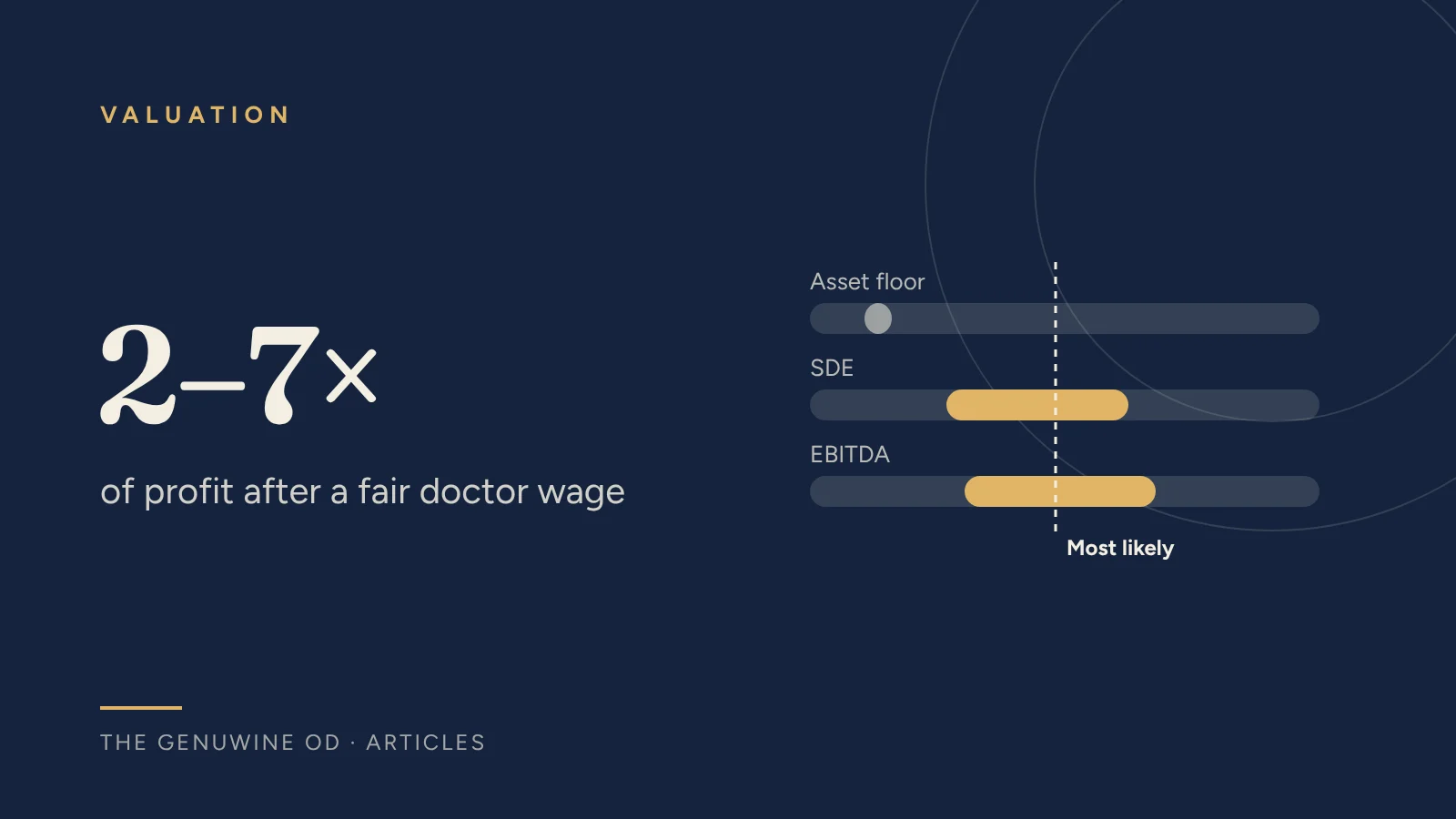
Most ODs first hear what a practice is "worth" from the asking price. I've bought, sold and started clinics, and I've looked at the books for more than 100 practices, and the asking price is almost never where I start. It's the seller's opening number in a negotiation.
What a practice is worth comes down to one thing: how much profit is left after you pay someone to do the eye exams. That's what you're actually buying, and it's what your lender will lend against. Collections tell you how busy a clinic is. Profit tells you what it's worth.
There are three ways buyers, sellers and lenders get to a number. Each one answers a slightly different question, so you want all three.
Method 1: What the practice owns
Start with the assets. Add up the equipment, furniture, computers and frame inventory at what they'd sell for today. What they cost five years ago doesn't matter.
Think of this as the floor. A practice with weak profit is still worth roughly its assets, but rarely much more. For a healthy practice, the asset value usually sits far below the other two numbers, so it mostly comes into play when a clinic isn't earning much.
Method 2: A multiple of SDE
SDE stands for seller's discretionary earnings. It's the profit available to one owner who also works as the doctor, and you build it like this:
SDE = net profit + owner's pay + interest + depreciation and amortization + documented add-backs
Add-backs are costs the current owner runs through the clinic that a new owner won't have. A personal car lease is a common one, or a one-time legal bill. Here's the rule I follow on every deal I look at: if there's no paperwork behind an add-back, it counts as zero.
SDE works best for smaller, one-doctor practices, because the buyer is usually stepping into the seller's chair.
Method 3: A multiple of EBITDA, after paying the doctor
For larger practices, I care about the profit left after paying someone a fair market wage to do the clinical work:
Adjusted EBITDA = SDE minus a market doctor wage for the days the owner works
Value = adjusted EBITDA × multiple
This is the step that separates two clinics that look identical from the outside. Here are two practices that both collect a million dollars a year:
| Clinic A | Clinic B | |
|---|---|---|
| Collections | $1,000,000 | $1,000,000 |
| EBITDA | $240,000 | $350,000 |
| Minus market doctor pay | −$150,000 | −$150,000 |
| Profit you're actually buying | $90,000 | $200,000 |
| Value at 2–7× | $180K–$630K | $400K–$1.4M |
Clinic B is worth more than twice as much on the same revenue. Put another way, every extra $10,000 of yearly profit adds somewhere between $20,000 and $70,000 to the sale price.
So what multiple should you use?
From the deals I've been part of, practices usually sell for about 2 to 7 times EBITDA after a market doctor wage. US brokers tend to quote 4 to 7 times. Keep in mind that brokers and consultants get paid when deals close.
Where a practice falls in that range depends on a handful of things. Owner dependence matters most. If the seller does 80% of the exams and plans to leave the week you take over, a lot of patients may leave too. A three-year upward trend in collections is worth more than one strong year. The lease matters more than people expect: how many years are left, the renewal options, and whether the landlord will assign it to you. And clean books with a stable team will always push the number up.
Why I don't trust "60 to 80% of revenue"
You'll hear the rule of thumb that practices sell for 60 to 80% of collections. Watch what happens when you apply it to the two clinics above. At 60%, both are priced at $600,000. Financed at 7% over 10 years, the loan costs about $83,600 a year.
| Clinic A | Clinic B | |
|---|---|---|
| Yearly loan payments | $83,600 | $83,600 |
| Profit left after the loan | $6,400 | $116,400 |
| Debt coverage | 1.08× | 2.39× |
Clinic A can barely make its payments, and most lenders want coverage of about 1.25× before they'll fund a deal. Clinic B at the same price is a bargain. The rule gave the same answer for two very different businesses, which is why I only use it to check that a number isn't wildly off.
Putting the three methods together
I blend them based on the size of the practice. For a small, one-doctor clinic I lean on SDE, since the buyer will probably replace the seller in the exam room. For a larger, multi-doctor practice I lean on EBITDA, because you're buying a business that already pays its doctors. The asset value stays as a floor, and it shouldn't drag the blended number down.
Here's a fictional example. A practice collects $1.25 million. Net profit is $180,000, the owner pays themselves $140,000, interest and depreciation add up to $45,000, and there's $15,000 of add-backs with receipts. That gives an SDE of $380,000. The practice has two doctors and the owner works four days a week. Blending the methods puts the valuation estimate at about $1.1 million, inside a range of roughly $830,000 to $1.43 million.
Then I ask the question that decides most deals: can a buyer actually finance that price? At $1.1 million, last year's cash flow covers the new loan payments about 1.35 times, so a lender can probably back it. I call that the financeable price, and in my experience it's often the real ceiling on a deal. I explain how lenders run that test in my article on debt service coverage.
Before you trust any number, including mine
Get three years of financial statements and line them up against the practice management system's collection reports. If the two don't agree, find out why before you go any further. Rebuild SDE yourself and question every add-back. Use a market doctor wage that's real for your city, not the one that makes the math work. And test the price against the loan before you make an offer.
A valuation estimate like this is a planning tool. Before you sign anything, get a formal valuation from a qualified professional and have your accountant and lawyer go through the deal with you.
Common questions
What multiple do optometry practices sell for?
In my experience, practices usually sell for about 2 to 7 times EBITDA after paying a fair market doctor wage. US brokers often report 4 to 7 times. Smaller, owner-dependent and rural practices sit at the low end. Practices that run without the owner sit at the high end.
Is a percentage of revenue a good way to value a practice?
Only as a rough sanity check. Two practices with the same collections can have very different profit, so the same revenue multiple can be a bargain for one and a money-loser for the other.
What is SDE in an optometry practice?
Seller's discretionary earnings: the profit available to one owner who also works as the doctor. You get it by adding the owner's pay, interest, depreciation, amortization and documented personal or one-time costs back to net profit.
General education, not financial, lending, legal or tax advice. Numbers are examples and vary by location, practice type and situation. Confirm the rules with your lender, accountant and lawyer.
Keep reading

Buying an Optometry Practice: A Step-by-Step Guide for ODs
How to buy an optometry practice for sale: what to check in the financials, how to value it, how lenders decide, and the red flags to catch before you sign.
Using an SBA Loan to Buy an Optometry Practice: The October 2026 Rules
How SBA 7(a) loans work for buying an optometry practice under the rules effective October 1, 2026: last year's cash flow, 1.25x coverage, 10% equity, seller notes.
Debt Service Coverage Ratio (DSCR): Formula, Examples and What Lenders Want
The debt service coverage ratio formula explained with clinic examples: how to calculate DSCR, what a good ratio is, why 1.25x matters, and 6 ways to raise yours.