Running a practice
Optometry Practice Profit Margins: P&L Benchmarks for Clinic Owners
 By Dr. Davinder Sidhu, OD
November 11, 2026 · 3 min read
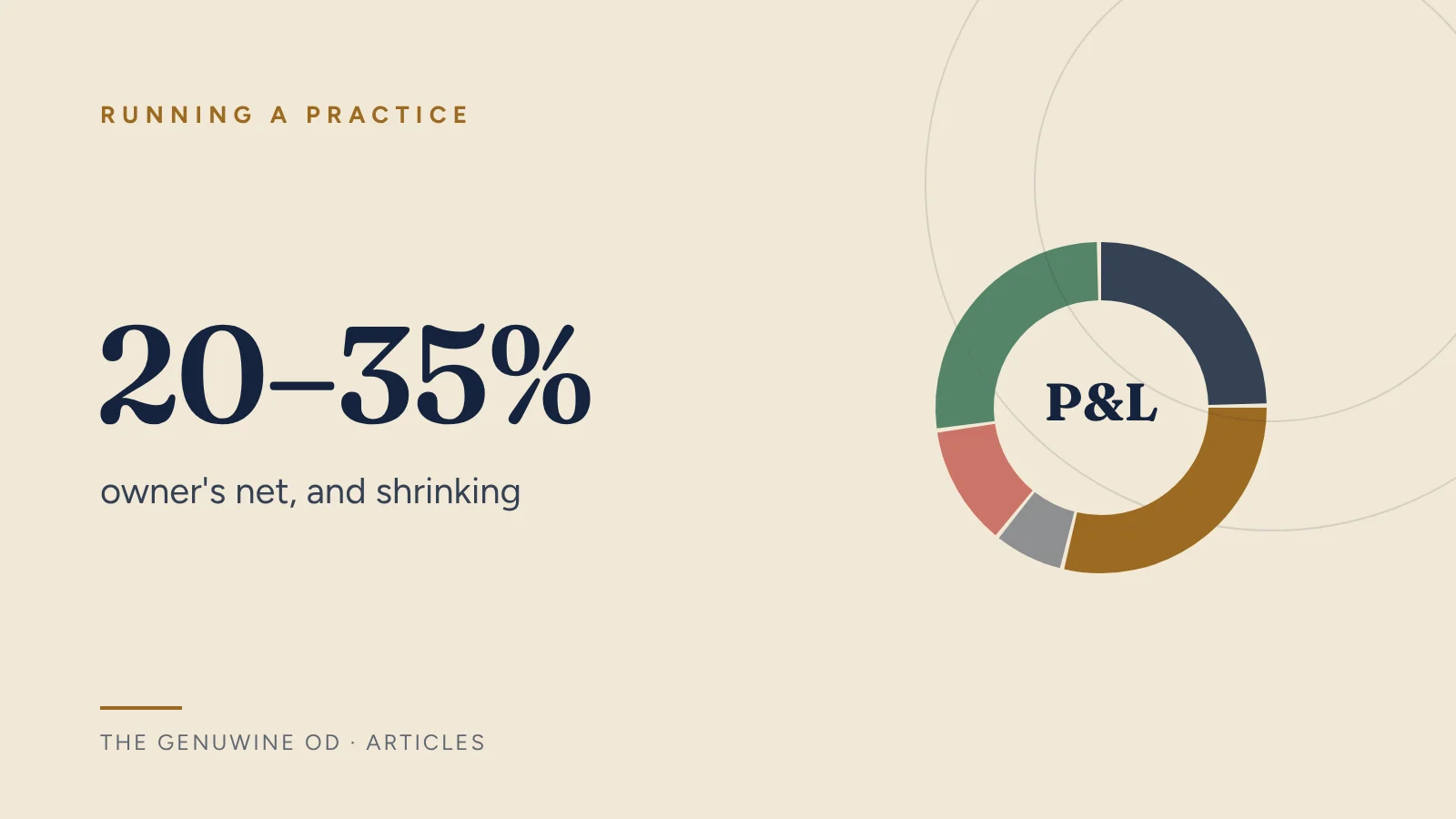
Your clinic made money last year, but that doesn't tell you whether it made enough. The way I check is to turn every big line on the P&L into a percentage of collections, then compare those percentages with what's typical.
These ranges move with location, the type of practice and the situation you're in, so treat them as a place to start and run the math on your own numbers.
Where the money usually goes
| Line item | How to calculate | Typical range |
|---|---|---|
| Owner's net, before paying yourself for clinical work | Net income ÷ collections | 20–35%, and shrinking |
| Non-doctor payroll | Staff wages ÷ collections | 21–28%, median around 25% |
| Cost of goods (frames, lenses, contacts, lab) | Product costs ÷ collections | 26–32% or higher, and rising |
| Eyewear gross margin | (Price − cost) ÷ price | About 61% (US median) |
| Occupancy (rent, utilities, upkeep) | Occupancy ÷ collections | 5–8% |
| Optical capture rate | Eyewear buyers ÷ exam patients | 60–70% in the US, 75%+ when it's run well |
Owner's net has come down over the last several years because staff wages and product costs have both gone up. A practice that ran at 35% a decade ago might be sitting at 25% today with the same patients.
When I look at staffing, I look at payroll as a percentage of collections rather than headcount. A clinic can feel short-staffed and still be overspending, or be fully staffed and lean.
Cost of goods is often the quickest place to find money, and the first thing I'd check is whether you're pricing from margin or from markup. A 100% markup is only a 50% margin.
Profit after paying the doctor
Net income on its own can hide a problem. If you're the doctor, part of that profit is really your wage for doing exams. Subtract what you'd have to pay someone else to do your clinical work, and what's left is the profit the business itself makes. That's also the number that decides what your practice is worth if you ever sell, which I go through in how much an optometry practice is worth.
Five formulas I use
Price from margin. Price = cost ÷ (1 − target margin). A $100 frame at a 61% margin should sell for $100 ÷ 0.39, which is about $256.
One point of capture rate. Exams × 1% × average sale × margin. With 3,000 exams a year, one extra point is 30 more sales. At $400 each and a 61% margin, that's about $7,320 a year.
Fee increase break-even. Increase ÷ (increase + contribution margin). A 3% increase with a 60% contribution margin works out to 3% ÷ 63%, or 4.8%. As long as you lose fewer patients than that, the increase pays for itself. This only applies to fees you set, not plan-set fees.
Patient retention. (Patients at the end of the year − new patients) ÷ patients at the start. If you started with 2,000, ended with 2,100 and 300 were new, retention is 90%. New patients can easily hide the ones who quietly left.
Associate break-even. Added fixed costs ÷ (1 − pay % − product %). With $70,000 of added costs, 25% pay and 25% product, an associate needs to collect $140,000 before they add any profit.
Check yours in two minutes
My free P&L Health Check compares your cost of goods, staff, rent and owner's net with these ranges and shows your real profit after a fair doctor wage. It runs in your browser, and nothing you type is saved.
Common questions
What is a good profit margin for an optometry practice?
Owner's net, before paying the owner for clinical work, often runs around 20% to 35% of collections. It has been shrinking as staff and product costs rise.
What percentage of revenue should staff costs be in an optometry practice?
Non-doctor payroll often runs around 21% to 28% of collections, with a median near 25%. Wages have climbed fastest in the last few years.
What is a good optical capture rate?
In the US, 60% to 70% of exam patients buying eyewear is common, and 75% or more for well-run dispensaries. There is no public Canadian benchmark.
General education, not financial, lending, legal or tax advice. Numbers are examples and vary by location, practice type and situation. Confirm the rules with your lender, accountant and lawyer.
Keep reading
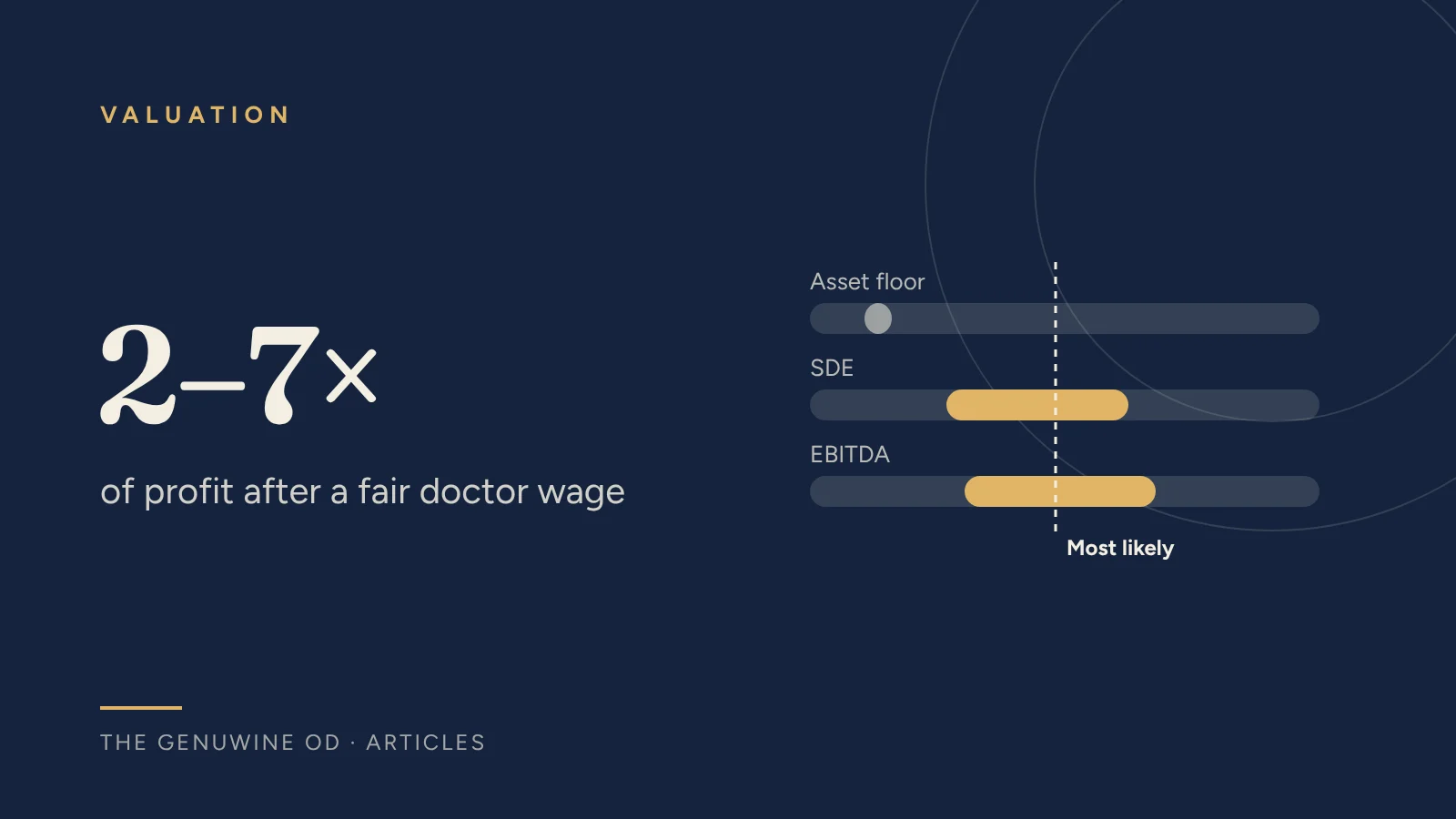
How Much Is an Optometry Practice Worth? The 3 Methods Buyers and Lenders Use
How optometry practices are valued: asset value, SDE and EBITDA multiples, why revenue rules of thumb mislead, and a worked example with real formulas.

Buying an Optometry Practice: A Step-by-Step Guide for ODs
How to buy an optometry practice for sale: what to check in the financials, how to value it, how lenders decide, and the red flags to catch before you sign.
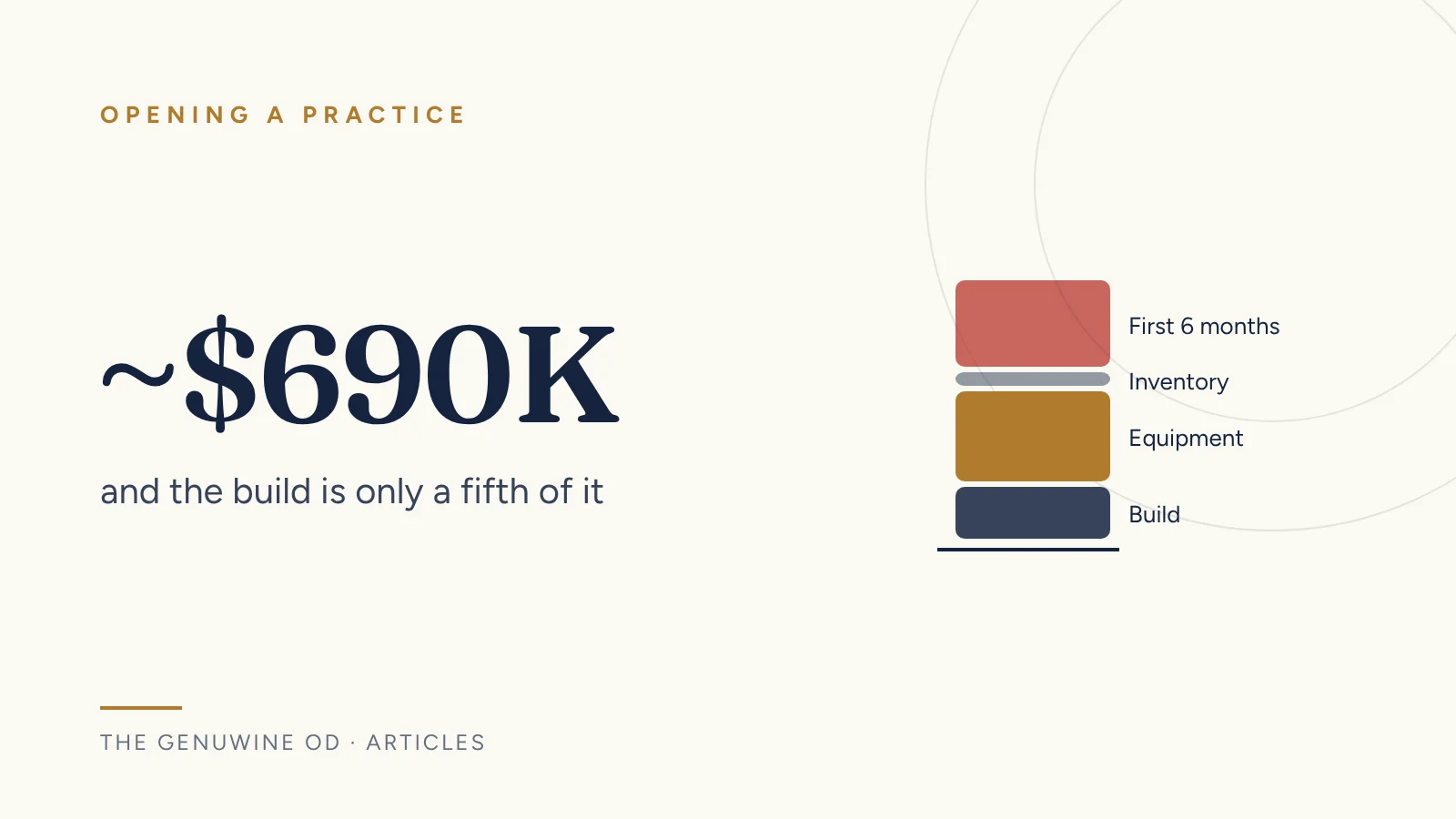
How Much Does It Cost to Open an Optometry Practice?
A line-by-line budget for opening an optometry practice: build-out, equipment, inventory, pre-opening costs and the working capital most new owners forget.